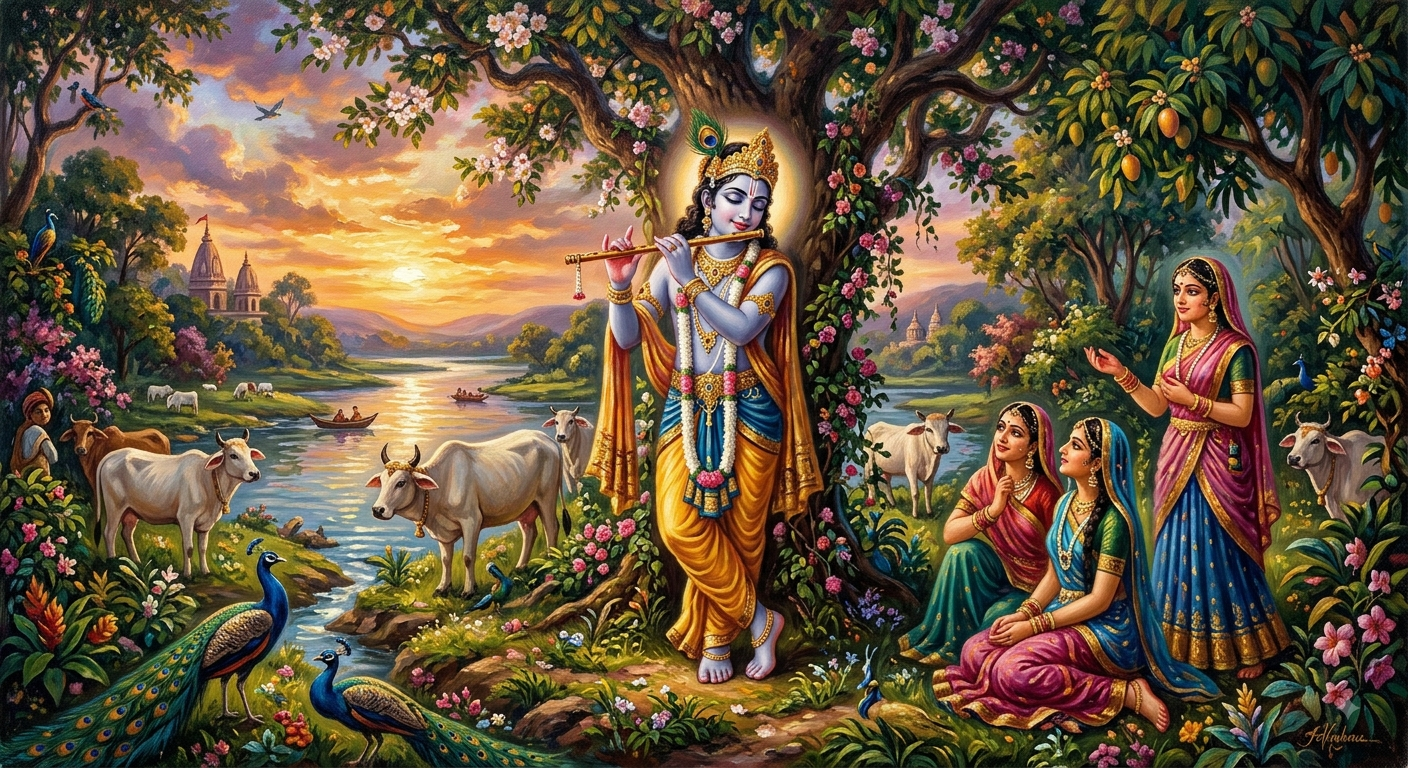

There are gods we worship from a distance, and then there is Krishna — the one we fall in love with. I say this as someone who has spent months now sitting with his words in the Bhagavad Gita, verse by verse, and I can tell you: the more time you spend with him, the less he feels like a deity in a temple and the more he feels like someone who already knows you, and loves you anyway.
The God Who Plays
My first image of Krishna, like most of ours, is not the philosopher on the battlefield — it’s the child in Vrindavan. The butter thief. The one who charms his way out of trouble with his mother Yashoda, who dances in the moonlight with the gopis, who lifts an entire hill on the tip of his little finger like it’s nothing at all.
I used to think this was just charming mythology — stories for children, softened divinity. I don’t think that anymore. I think Krishna chose to reveal himself first as play — as lila — because he wanted us to understand something before we understood anything else about him: that the universe, at its root, is not grim. It is not a burden God carries reluctantly. It is joy, expressing itself as creation. Before Krishna teaches us anything about duty or the soul, he shows us a child stealing butter and laughing. That’s not incidental. That’s theology.
The Friend Who Becomes the Charioteer
Then comes Kurukshetra, and Krishna does something that still moves me every time I sit with it: the Lord of all worlds, a king in his own right, chooses to hold the reins of another man’s chariot. Not the throne. Not the army. The reins.
Arjuna, paralyzed by grief and doubt at the edge of the greatest war of his life, turns to his friend — and it is only then, in that moment of complete surrender, that Krishna speaks the Gita. I find this detail impossible to move past: the deepest teaching in Hindu scripture isn’t delivered from a pulpit. It’s delivered to a friend, in a chariot, in the middle of a battlefield, because a friend was breaking down and needed him.
That is who Krishna is to a devotee. Not a distant sovereign issuing commandments. A friend who gets in the chariot with you.
What He Actually Asks of Us
If I’m honest, what draws me to Krishna isn’t just his beauty or his charm — it’s the strange, quiet radicalism of what he asks. He doesn’t ask Arjuna to win. He asks him to act, fully, without clinging to the fruit of the action:
“You have the right to your actions, but never to the fruits of your actions.” (2.47)
Sit with that for a moment. Most of our suffering — certainly mine — comes from gripping outcomes too tightly. Krishna isn’t asking for indifference or passivity. He’s asking for something much harder: full-hearted engagement, released from the anxiety of control. That single verse alone has quietly restructured how I move through ordinary days, long after I’ve closed the book.
And then, later, he goes further — he asks not just for right action, but for the heart itself:
“Abandon all varieties of dharma and simply surrender unto Me.” (18.66)
This is the verse that, to me, is the whole of bhakti compressed into a single line. Not “follow more rules.” Not “perform more rituals.” Surrender the self that keeps insisting on managing its own salvation, and let go into him. It’s terrifying advice, honestly. It’s also the only advice that has ever actually loosened anything in me.
The Form That Undoes You
There is a moment in Chapter 11 that I think devotional retellings sometimes rush past too quickly, because it isn’t comfortable. Arjuna asks to see Krishna’s true, universal form — and what he sees is not simply glorious. It’s overwhelming, almost unbearable — mouths blazing like the fires at the end of time, the whole universe being devoured before his eyes. Krishna himself says it plainly:
“I am time, the destroyer of worlds.” (11.32)
I don’t think we’re meant to soften this. Krishna isn’t only the flute-player and the butter thief. He is also the one holding the whole of time — birth and death, creation and dissolution — in the same hand. A devotee who only wants the sweetness of Vrindavan hasn’t yet met the whole of him. But this is the strange comfort I’ve found in it: the same being who contains all that vastness and terror is the one who, a few verses later, gently returns to his familiar form and comforts a trembling Arjuna like an old friend. Both are Krishna. The immensity and the tenderness are not in tension — they’re the same love, seen from two different distances.
Why I Keep Returning
I won’t pretend I’ve resolved every question I have about him — how a personal, playful god who steals butter is also the impersonal ground of all being; how surrender and self-effort fit together; how a being of infinite compassion also stands, unflinching, as time itself. I don’t think these are questions Krishna wants resolved into a neat sentence. I think he wants us to keep living inside them.
What keeps me coming back to him isn’t certainty. It’s that he never once, in seven hundred verses, asks Arjuna to stop being himself. He asks him to see clearly, to act without grasping, and to love without condition — and then leaves the fighting, the living, the choosing, entirely in Arjuna’s own hands.
That, to me, is the mark of real love. Not a god who does it for you. A friend who sits beside you in the chariot until you’re ready to pick up the reins yourself.
Jai Shri Krishna.
